



MANUFACTURING
How to Choose the Right Carbide Cutting Tool for CNC, Routers and Machining
Apr
How to Choose the Right Carbide Cutting Tools for CNC, Routers and Machining Applications
If you’ve ever snapped a tool mid cut, burned through material, or not been sure why your finish looks terrible, this is for you. Using the wrong cutter will cost you whether you’re running a machining centre, a router, or simply using a tool for hand application. Getting it wrong means poor results, wasted material, and money down the drain. Choosing the right carbide cutting tool does not need to be complicated, but understanding a few basics will save you time, money, and frustration.
What Are Carbide Cutting Tools?
Carbide cutting tools are some of the most precise, rigid, and repeatable tool options available and are used across a wide range of industries and applications. The material itself is made by combining tungsten carbide powder with a metal binder, which in most cases is cobalt. The result is a material that stays sharp under serious heat and pressure and will outlast high speed steel by a significant margin.
In many machining applications, carbide tools can last 3 to 10 times longer than high speed steel depending on the material and cutting conditions. But the material alone does not make a great tool. Performance also comes down to geometry, tolerances, and choosing the right coating for the job.
Why Carbide Tool Selection Matters
The right tool is the difference between a job that comes out exactly how it should and one that does not. Get it right and the results show immediately. You will have a better finish, longer tool life, and a process that runs the way it should.
The wrong tool creates heat, chatter, poor finish, short tool life, and wasted parts. Over time, these small problems compound into serious costs through scrap, rework, and downtime.
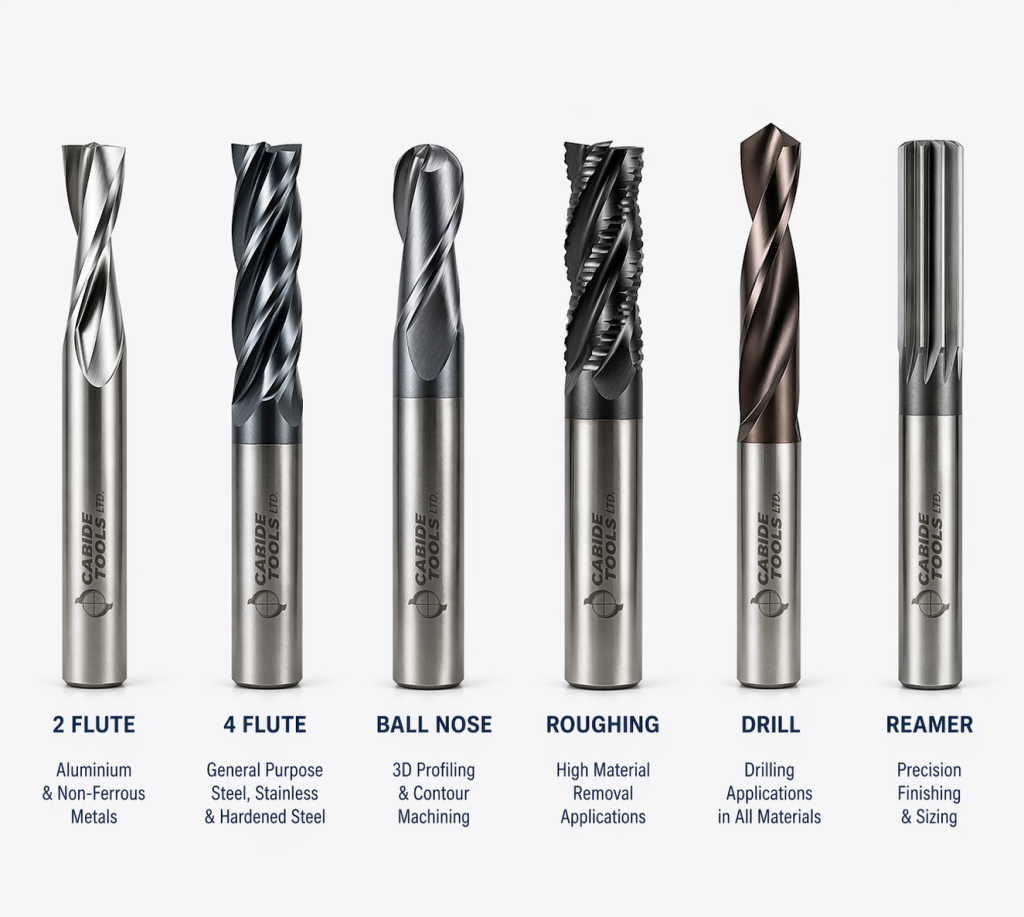
Types of Carbide Cutting Tools and Their Uses
There are a wide range of carbide cutting tools out there, each designed for a specific job. These are the main categories and what they’re used for.
- Square, ball nose, and corner radius
- Roughing, finishing, slotting, high feed
- High helix and variable geometry
- Aluminium (high helix, polished)
- Wood & router (upcut, downcut)
- Plastic & composite (O-flute, compression)
- Drills (standard and custom)
- Reamers (standard and precision)
- Chamfer tools
- Counterbores
- Deburring, engraving, contouring
- Chip breaker tools
- Deep slotting and thin wall
- High-performance application-specific
- Profile and form tools
- Multi-step / combination tools
- Job-specific cutter designs
If you don’t know where your job sits, that’s what a good supplier is for.
Understanding Carbide Tool Geometry
Tool geometry is what separates a clean cut from a poor one. Three key factors matter most.
These three factors are where most tooling mistakes happen. Getting them right is one of the easiest ways to improve both finish and tool life.
Matching Carbide Cutting Tools to Materials
Different materials behave very differently under a cutting tool. Matching the tool to the material is one of the most important decisions in the entire process.
How Machine Setup Affects Carbide Tool Performance
Even the best cutting tool will struggle on a machine that is working against it. Spindle runout, rigidity, tool holding, and vibration all directly impact performance.
Runout as small as 0.02 mm can reduce tool life significantly by causing uneven cutting loads across the cutting edge. Poor rigidity leads to chatter, which damages both the tool and the workpiece.
In simple terms, the tool, material, and machine must all work together. If one is off, the whole process suffers.
Carbide Tool Coatings Explained
Coatings are often misunderstood. They improve performance by reducing friction, managing heat, and increasing wear resistance, but they are not a fix for poor tool selection or bad geometry.
In lower volume work, coatings are not always necessary. In production, they can make a big difference in tool life and consistency.
Cheap vs Premium Carbide Tools: What Actually Saves Money
The real cost of a tool is not what you pay upfront. It is what it costs you over time.
Cheap tools can work well for simple or low-risk jobs. But in demanding or production environments, they often lead to higher overall costs through breakage, inconsistency, and downtime.
Premium tools are more consistent, last longer, and reduce the risk of failure. In most production settings, they lower the cost per part even though they cost more initially.
Carbide Tool Regrinding: Save Money and Extend Tool Life
A carbide tool regrind can restore a worn tool for a fraction of the cost of a new one. Many tools can be reground multiple times if maintained properly.
Regrinding at the right time can reduce tooling costs by 30–70% over the life of a tool. Leave it too late and there may not be enough material left to recover it.
Not Sure Which Tool Is Right for Your Job?
If you’re unsure, you don’t need all the answers. Tell us what material you’re cutting, what machine you’re running, and what result you need. We’ll help point you in the right direction.
Get in touch with our team or explore our carbide cutting tools and custom tooling solutions.
Choosing the Right Carbide Cutting Tool
Choosing the right tool is not about knowing everything. It is about understanding the basics and asking the right questions.
You need to consider three things: the material, the machine, and the outcome you want. When those three line up, the results improve straight away.
The right tool will cut cleaner, last longer, and reduce the overall cost of the job. The wrong tool will quietly cost you through poor finish, wasted material, and lost time.
When in doubt, ask. A good supplier will help you make the right call, and that decision is often the difference between a job that struggles and one that runs properly from the start.
Frequently Asked Questions About Carbide Cutting Tools
Common questions about carbide cutting tools, custom tooling, and regrinding services in New Zealand.
How much longer do carbide tools last than HSS?
Carbide tools typically last 3–10 times longer depending on the material, machine setup, and cutting conditions. In lighter work the difference may be smaller, but in more demanding machining carbide usually lasts far longer and holds its edge better under heat.
Why does my tool keep breaking?
This is usually caused by incorrect geometry, poor machine setup, excessive runout, poor rigidity, or incorrect feeds and speeds. In many cases, the tool itself is not the full problem. The material, the machine, and the setup all have to work together.
Are coatings always necessary?
No. Coatings are most useful in high volume or demanding applications where heat, friction, and wear become more of a problem. For lighter work or softer materials, uncoated tools are often perfectly suitable.
When should I use custom tooling?
Custom tooling makes sense when standard tools cannot meet performance, efficiency, or tolerance requirements, or when you are repeating the same job frequently and want to reduce cycle time, improve finish, or combine multiple operations into one tool.
Can carbide tools be reground more than once?
Yes, many quality carbide tools can be reground multiple times, depending on the geometry, how heavily they have been worn, and how much carbide remains. Regrinding earlier usually gives you a better chance of getting more total life from the tool.
Is a premium carbide tool always worth buying?
Not always. For one-off or low-risk work, a cheaper tool may do the job well enough. But in production, harder materials, or tighter tolerance work, a premium tool often saves money overall through better consistency, longer life, and less downtime.
Sources and Industry References
- Sandvik Coromant – Metal Cutting Technology Guide
- Kennametal – Metal Cutting Fundamentals
- ASM Handbook, Volume 16: Machining
- ISO 8688 Tool Life Testing Standards
- Machining Data Handbook (Machinability Data Center)
- International Journal of Machine Tools and Manufacture